
Altcoin liquidity is the practical answer to a question every holder eventually asks: if I want out, who buys? Liquidity, in this analysis, is the supply of willing buyers and sellers at prices near the current one. When it is deep, large sell orders move the price little. When it is thin, the same order can cut through the book and the price can gap down.
Float matters just as much. The float is the share of a token's total supply actually circulating and available to trade. Tokens with a small float relative to total supply can look stable in an uptrend and then fall hard once locked tokens start moving. This piece explains the mechanics as a framework: what float is, how order-book depth works, and where sellers may find no buyers.
A quick definition first. In crypto, a token is a digital asset created and managed by a smart contract on an existing blockchain rather than running its own network, as OpenSea's learning guide explains. That matters for liquidity because the underlying contract defines total supply, who holds it, and how tokens can be created, transferred or destroyed — the raw inputs of every float calculation.
What is circulating float, and why does it matter?
Circulating float is the portion of a token's supply that is liquid and tradable right now. The rest sits in team treasuries, investor vesting schedules, staking contracts, or reserve wallets. A token can have a huge total supply and a tiny float. That gap is where surprise drawdowns can begin.
Why? Price is set at the margin. If only a small slice of supply trades, a modest amount of buying can push the price up sharply, because sellers are scarce. The same arithmetic runs in reverse. When early holders or treasury wallets finally sell into that small float, there may not be enough buyers at recent prices, and the decline can be fast.
This is why unlock schedules deserve as much attention as launch narratives. A vesting calendar that releases a large allocation into a thin market is a standing supply overhang. The core point is simple: the float today is not necessarily the float next quarter, and the market may price the difference late.
One caution applies. Circulating-supply figures come from projects and data aggregators, and an exchange or project is the attributed source of its own metrics — never independent verification of them. Wallets can be mislabeled, and some locked supply is less locked than it looks. Treat any float number as an estimate with a margin of error, not a fact.
How does order-book depth determine how far a price falls?
An order book is the list of resting buy and sell orders at each price on an exchange. Depth is how much volume sits within a few percent of the current price. Depth acts as the shock absorber. A sell order must consume the bids beneath it, level by level, and each level it eats pushes the traded price lower.
With deep books, a large sale barely dents the price because many bids sit close together. With thin books — common for smaller altcoins — a sale of modest size can sweep the entire visible bid wall. The last trade prints far below where the seller started, and the chart shows a vertical drop that reflects no change in fundamentals, only a change in who was willing to buy.
Depth also differs by venue. A token may show healthy depth on one large exchange and almost none on smaller ones, and quoted prices can drift apart when arbitrage is slow or expensive. The depth a seller actually reaches depends on where the order lands, not on the best quote anywhere.
Automated market makers change the picture. Instead of an order book, an AMM pool prices trades through a formula based on the assets held in the pool. A pool with a small reserve of the altcoin side can behave like a thin book: each sale shifts the ratio and the price can move against the seller faster as the pool drains. Same mechanism, different plumbing.
What does locked supply do in a drawdown?
Locked supply cuts both ways, and the direction can flip with the market. In an uptrend, staking contracts and vesting locks hold supply off the market, which tightens the float and can amplify gains. In a drawdown, those same locks can become a queue of future sellers. Tokens that unlock during falling prices tend to be sold into falling prices.
Staking adds a second layer. Tokens pledged to secure a proof-of-stake network are committed for a period, and unstaking typically involves a waiting window. The liquidity consequence is direct: staked supply cannot be sold immediately, so real sellable float is smaller than headline circulating supply suggests — and when fear spreads, many holders can request exits at once and the unstaking queue becomes visible pressure. We covered a connected angle in How Proof-of-Stake Rewards Work, and What the SEC's 2025 Guidance Changed.
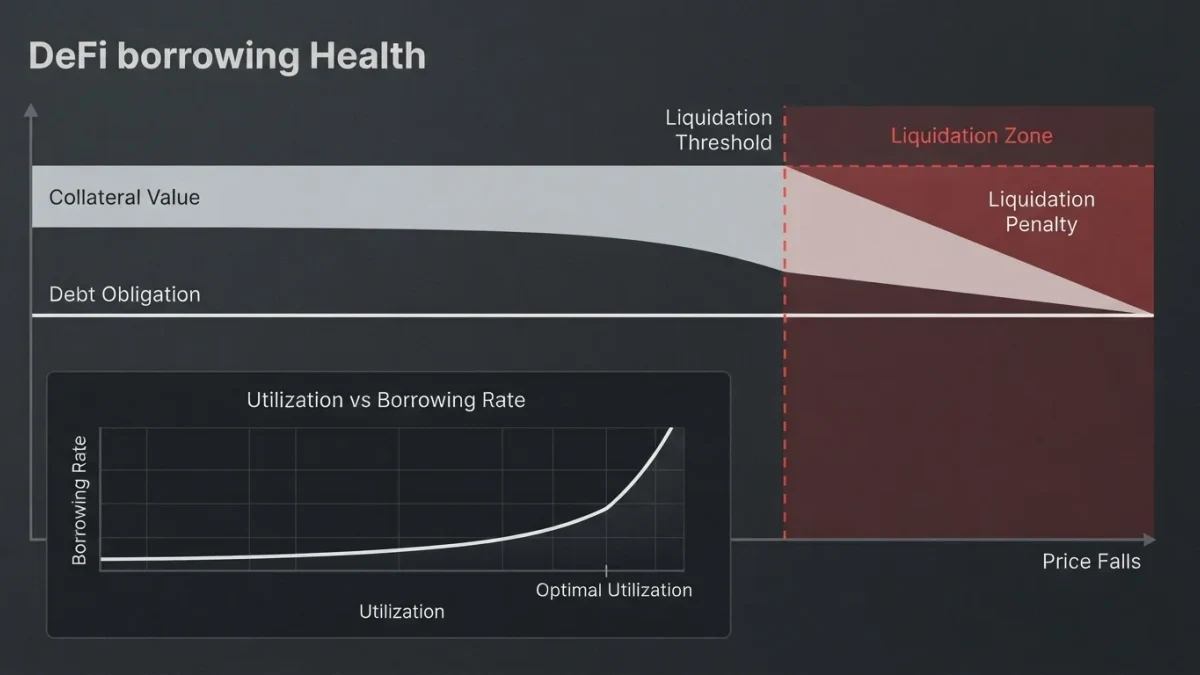
A sharper version of this problem can appear in collateral. Tokens pledged in lending markets can become forced sellers when their collateral value drops. In this framework, cascades are liquidity events, not opinion events: price falls, collateral gets liquidated, liquidation sells push price down further, and the loop repeats until the book finds real buyers. For related coverage, see How DeFi Lending and Collateral Actually Work.
Where do sellers find no buyers?
Exit liquidity can disappear in predictable places. Knowing the map is more useful than any single price chart.
- Small listing venues. A token quoted on one or two minor exchanges has thin aggregated depth. The bid side can be nearly empty during stress.
- Off-hours markets. Crypto trades continuously, but human market makers are not equally active at all hours. Depth at thin hours can be a fraction of peak-hours depth.
- Tokens with concentrated holdings. When a few wallets hold most of the float, everyone else is a small holder by definition, and the first large mover out sets the price for everyone behind them.
- New launches. Memecoin-style launches can concentrate supply with insiders and early buyers, and the unwind of that structure is, mechanically, a liquidity event.
- Pegged assets under stress. When a stablecoin's peg strains, holders can all want the same exit at once, and the exit door narrows exactly when it is needed most.
The common thread: exit liquidity is a feature of market structure, not of sentiment. Sentiment decides when everyone heads for the door. Structure decides whether the door is wide enough.
What this means for reading an altcoin's risk
Our analysis, reading the mechanics above: the downside of a thin-float, thin-depth token is structurally larger than its chart history implies, because the chart was drawn under conditions that reverse in a drawdown. Past performance is never a pattern that predicts, and crypto markets are volatile — losses are possible on any position.
Practical checks, stated as questions rather than directives: How much of total supply is circulating, and what unlocks next? How deep are the books within a few percent of the price, on the venues that matter? How concentrated are the top holders? Is reported supply staked, collateralized, or otherwise not actually sellable? None of these answers guarantees an outcome. Together they describe how hard the exit door will be to open.
It also helps to keep the vocabulary straight. Industry usage varies: some writers use "token" for any cryptoasset other than Bitcoin, a meaning close to "altcoin," while others reserve it for assets issued by smart contract on another chain, as Bitcoin.com's beginner guide notes. For this article the distinction matters only where it affects supply: what counts is what is tradable, what is locked, and who holds the rest.
The limits of what liquidity analysis can tell you
Liquidity and float analysis establishes structure: how much supply can hit the market, how deep the bids are, and where the exit narrows. It does not establish direction. A deep-float token with wide distribution can still fall on bad news, and a thin-float token can rally on good news. What the structure suggests is the shape of the move — how far price can travel on a given amount of selling.
The framework above describes the mechanism: price is set at the margin of tradable supply, order-book depth absorbs or transmits sell pressure, and locked supply becomes future supply. What remains unknown in any specific case is the timing of unlocks actually hitting the market, the true concentration of holdings, and the depth that will exist on the day it is needed. Those gaps are exactly where the surprises live. Checking the structure before the drawdown is the part of the work that can actually be done early.