
A bitcoin halving cycle is the roughly four-year interval between the network's programmed cuts to its block reward, the new coins paid to miners for adding blocks. The event matters to long-term holders for one mechanical reason: each halving cuts the rate of new supply in half, and supply is the one input in the market that no buyer, seller, or exchange can change. Per CoinMarketCap, the reward started at 50 bitcoins per block and is halved every 210,000 blocks, which the network takes about four years to produce.
The qualification matters as much as the mechanism. A halving reduces new supply; it does not create demand, and it does not guarantee a price move in either direction. The four-year pattern that traders talk about is an observed coincidence of past cycles, not a rule written into the protocol. What follows is what the halving actually does, what the historical record shows, and where the pattern is most likely to weaken.
What does the halving actually change?
The change is narrow and precise. Miners compete to add blocks, and the block reward is their main income. Every 210,000 blocks — roughly four years at the network's ten-minute target pace — the reward drops by 50 percent. CoinMarketCap's profile of Bitcoin records that the reward stood at 6.25 bitcoins after the 2020 halving, down from 50 at launch in 2009, and that total supply is capped at 21 million coins.
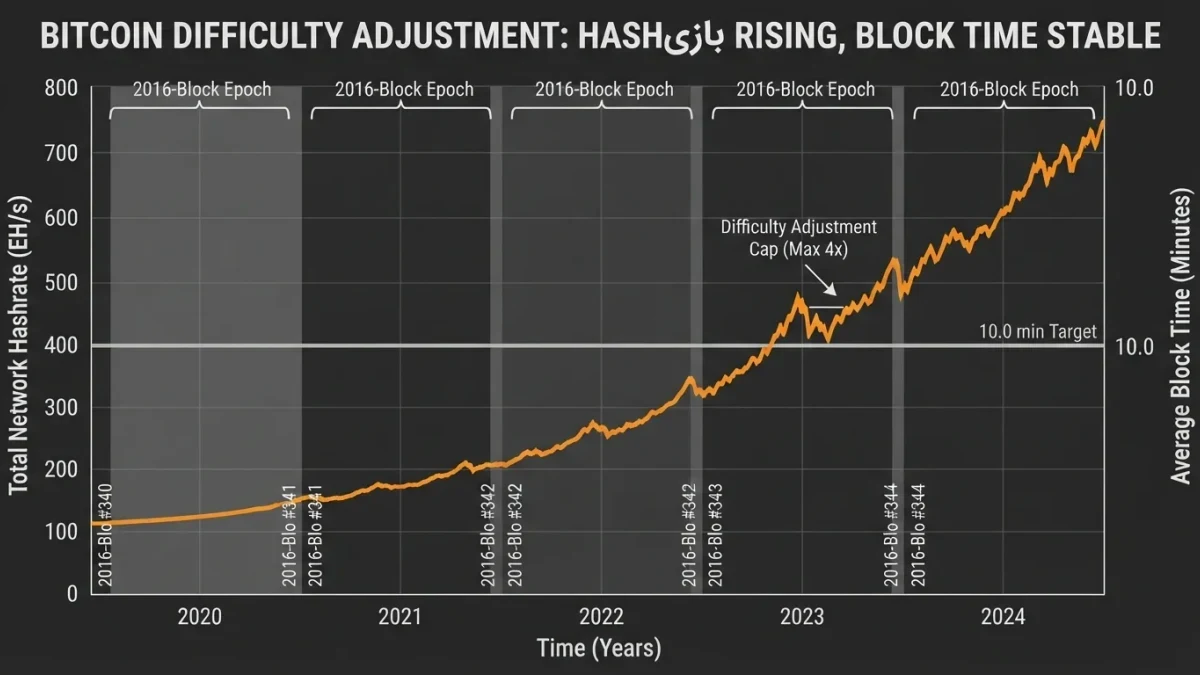
Two consequences follow. First, the inflation rate of new coins falls sharply with each event, and it falls toward zero as the sequence repeats. Second, miner revenue from new issuance falls in the same step, which pushes miners to lean harder on transaction fees and on efficiency. The difficulty adjustment, which recalibrates mining competition every 2,016 blocks, is what keeps the block schedule steady through these shocks — what Bitcoin's difficulty adjustment does every 2,016 blocks explains that mechanism in detail.
For a holder, the halving changes nothing about the coins they own. No keys move, no balances change. The effect is indirect: it alters the flow of coins entering the market from miners, who are structural sellers because they must cover electricity and hardware costs.
Why do traders call it a four-year cycle?
The label comes from history, not from code. Bitcoin's largest boom-and-bust stretches have each fallen within a few years of a halving, and market observers have folded that into a shorthand: accumulation in the years after a halving, rising prices as supply tightens, then a sharp drawdown. The pattern is real as a description of what happened. It is not a law of what must happen.
The price record shows how wide the swings are. TradingView's BTCUSD data notes a low of 2 dollars on October 20, 2011, and a high of 126,272 dollars on October 6, 2025 — a span that covers several complete cycles and every halving to date. The same data shows the drawdowns: BTC fell about 22.94 percent over the year leading into that reference window. Volatility of that size is the background condition a long-term holder lives in, halving or no halving.
The honest reading is that the halving is one known, scheduled supply event inside a market where demand is the dominant and unpredictable variable. Macro conditions, regulation, and fund flows have all moved Bitcoin by amounts a 50 percent supply cut cannot be cleanly separated from. Past cycles coincided with halvings; coincidence is not causation, and four observations make a thin sample.
What this means for accumulation behavior
Long-term holders — wallets that hold for years rather than weeks — tend to treat the post-halving period as a supply story worth watching, not a signal to act on. The practical logic runs like this:
- New issuance falls, so miners release fewer coins to the market each day.
- If demand holds steady, the reduced flow must be absorbed from existing holders, who typically sell at higher prices.
- If demand falls, the reduced flow does not prevent a drawdown, because existing holders and traders can still sell far more than miners do.
That third point is where halving-cycle narratives usually fail. Miner selling is a small slice of total volume; the rest of the market can overwhelm it in either direction. A holder who anchors expectations to the four-year clock is really making a demand forecast while calling it a supply observation.
Custody, not timing, is where holders have durable control. Whether coins sit on an exchange or in self-custody determines who bears the failure risk of the venue — a question this site treats separately in how Bitcoin cold storage and self-custody work. The mechanics of holding are unchanged by the halving; the risk of the counterparty is not.
Why the pattern may weaken as the reward shrinks
The supply shock is shrinking with every event. When the reward was 50 bitcoins, a halving removed 25 new bitcoins per block from issuance. Each subsequent halving removes half as much in absolute terms. The percentage change stays the same, but the dollar-sized disturbance to daily supply gets smaller, while the market's overall size gets larger. TradingView's key stats put circulating supply at 20.09 million of the 21 million cap, and market capitalization at 1.69 trillion dollars — a market that no longer needs issuance data to fill its order books.
There is a second, slower force: the halving schedule itself has an end. The reward keeps halving until it reaches the smallest unit the protocol can express, after which issuance stops entirely and miners live on fees alone. What happens when the last bitcoin is mined in 2140 covers that terminal state. As the network approaches it, the halving stops being a supply event of any market consequence and becomes a rounding error.
Our analysis of the mechanism, stated plainly: the four-year cycle is a historical pattern with a plausible partial supply-side explanation and no guarantee of continuation. Each cycle has also had a different demand driver — retail adoption, then institutions, then exchange-traded funds — and the drivers have not repeated on schedule. A holder building a plan around 2028 or 2032 dates is building it around the least reliable part of the story.
What long-term holders can actually do with this
The halving is one of the few events in markets with a known date years in advance, which makes it useful mainly as a calendar reminder rather than a trading signal. Reasonable uses of the information:
- Track miner economics around the event, since strained miners can add selling pressure; the mechanics are covered in how Bitcoin mining works.
- Watch the actual supply figures rather than the narrative; CoinMarketCap and on-chain dashboards publish issuance directly.
- Separate the custody decision from the market decision entirely, since the halving affects neither.
- Discount any forecast that treats the four-year pattern as a schedule the market is obliged to keep.
Crypto markets are volatile and losses are possible in any scenario, including the ones the cycle narrative calls favorable. Nothing here is investment advice. The evidence establishes that halvings cut issuance on a fixed schedule and that past cycles coincided with large price swings; it does not establish that the next halving will produce a particular outcome, and no source in this piece claims that it will.
The durable takeaway for a long-term holder is unglamorous. The halving is a protocol feature doing exactly what the code says, on a schedule anyone can verify. The cycle built around it is a market story, written and rewritten by demand. Holders who keep the two separate tend to make fewer expensive mistakes than holders who merge them.